
Bingham County Court Dockets Explained
A court docket is the court's running schedule and event list for a case. In Bingham County, docket information can include hearing dates, case type, case number, party names, judicial officer, event entries, continuances, payment review settings, and public disposition entries. The docket helps a reader track what happened and what is scheduled next. It does not always show the full text of a motion, affidavit, order, exhibit, or sealed filing.
Bingham County is part of Idaho's unified state court system. District Court hears felonies, civil cases usually over $10,000, post-conviction relief, and appeals from magistrate judges. The Magistrate Division handles misdemeanors, traffic infractions, small claims, probate, family, juvenile, civil cases under $10,000, warrants, and preliminary felony hearings. That structure affects dockets because many criminal cases begin in Magistrate Court before a felony is bound over to District Court.
The iCourt service hub is the statewide entry point for case, hearing, and payment tools used in Bingham County court docket checks.
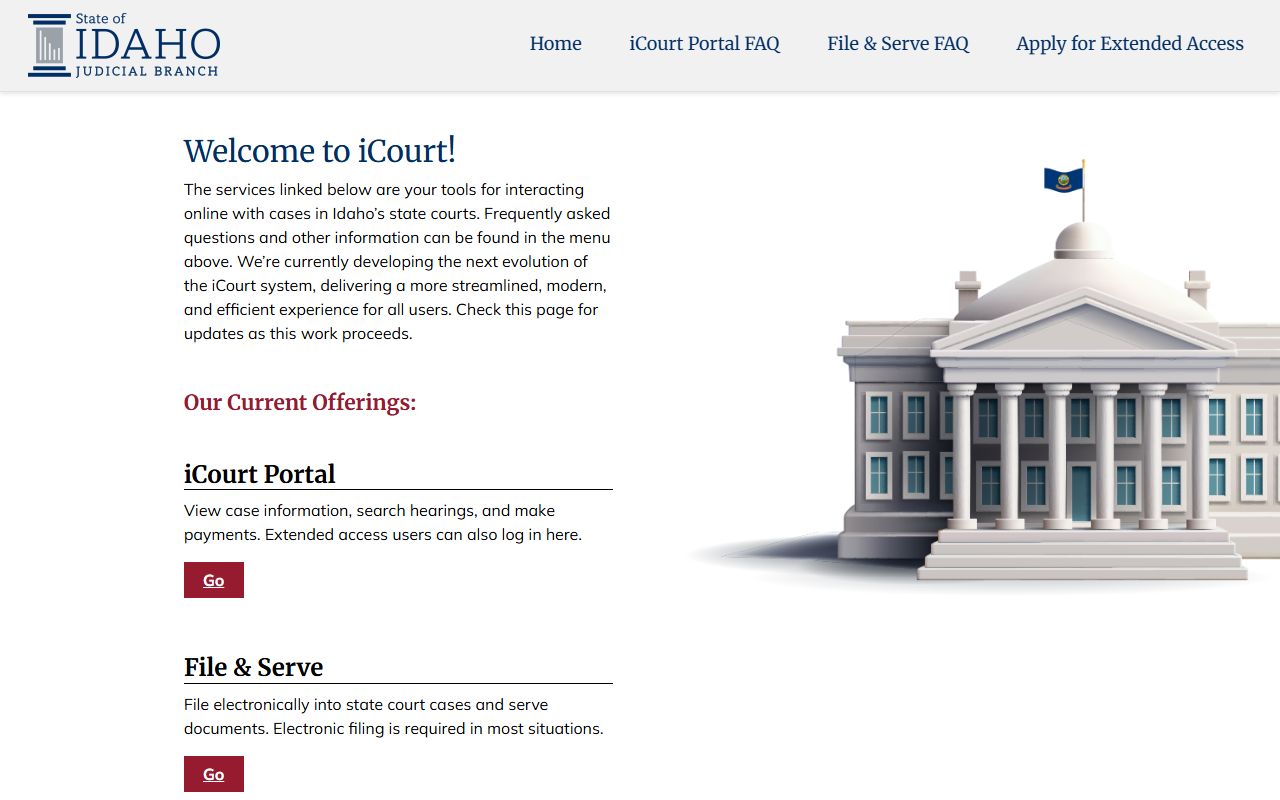
The hub matters for docket users because hearings, Smart Search records, and payment screens are separate tools that answer different questions.
Find Bingham County Court Dockets Online
The most direct online hearing path is iCourt Search Hearings. It lets public users search by location, hearing type, search type, and criteria. For Bingham County court dockets, the location should be set to Bingham County, then the hearing type can be narrowed to all hearings, civil, criminal, family, or probate and mental health. Smart Search can also show case events, but the hearing dashboard is built for calendar checks.
- Open iCourt Search Hearings and select Bingham County from the location field.
- Choose the Bingham hearing type that fits the case, such as Criminal, Civil, Family, or Probate or Mental Health.
- Select the search type: case number, party name, business name, attorney name, attorney bar number, judicial officer, or courtroom.
- Enter the search criteria and use "Sounds Like" only when name matching is uncertain.
- Review the public hearing result, then use Smart Search or the clerk's office if the full docket or document copy is needed.
Bingham County Hearing Search Fields
The hearing search fields are useful when a person knows a court date may exist but does not yet have the full case file. Bingham-specific hearing-type options were visible in research, which makes the dashboard more precise than a broad statewide name search. The tool also supports attorney and courtroom searches, but most public users will use case number or party name.
| Field Label | Type | Required | Options / Format Notes |
|---|---|---|---|
| Select Location | Dropdown | Yes | Includes all Idaho counties. Select Bingham County for local court dockets. |
| Select Hearing Types | Dropdown | Yes | Bingham - All Hearing Types; Bingham - Civil; Bingham - Criminal; Bingham - Family; Bingham - Probate or Mental Health. |
| Select Search Types | Dropdown | Yes | Case Number, Party Name, Business Name, Attorney Name, Attorney Bar Number, Judicial Officer, or Courtroom. |
| Sounds Like | Checkbox | No | Name matching aid when spelling may vary. |
| Search by Criteria | Text | Depends on selected type | Used for the chosen search type. |
| Last Name / First Name / Middle Name | Text | For party-name search | Party and hearing search fields. |
| Judicial Officer | Dropdown | Conditional | Statewide list; use only when the judge or magistrate is known. |
The iCourt payment screen matters for Bingham County court dockets because criminal and traffic payment status can connect to future review hearings.
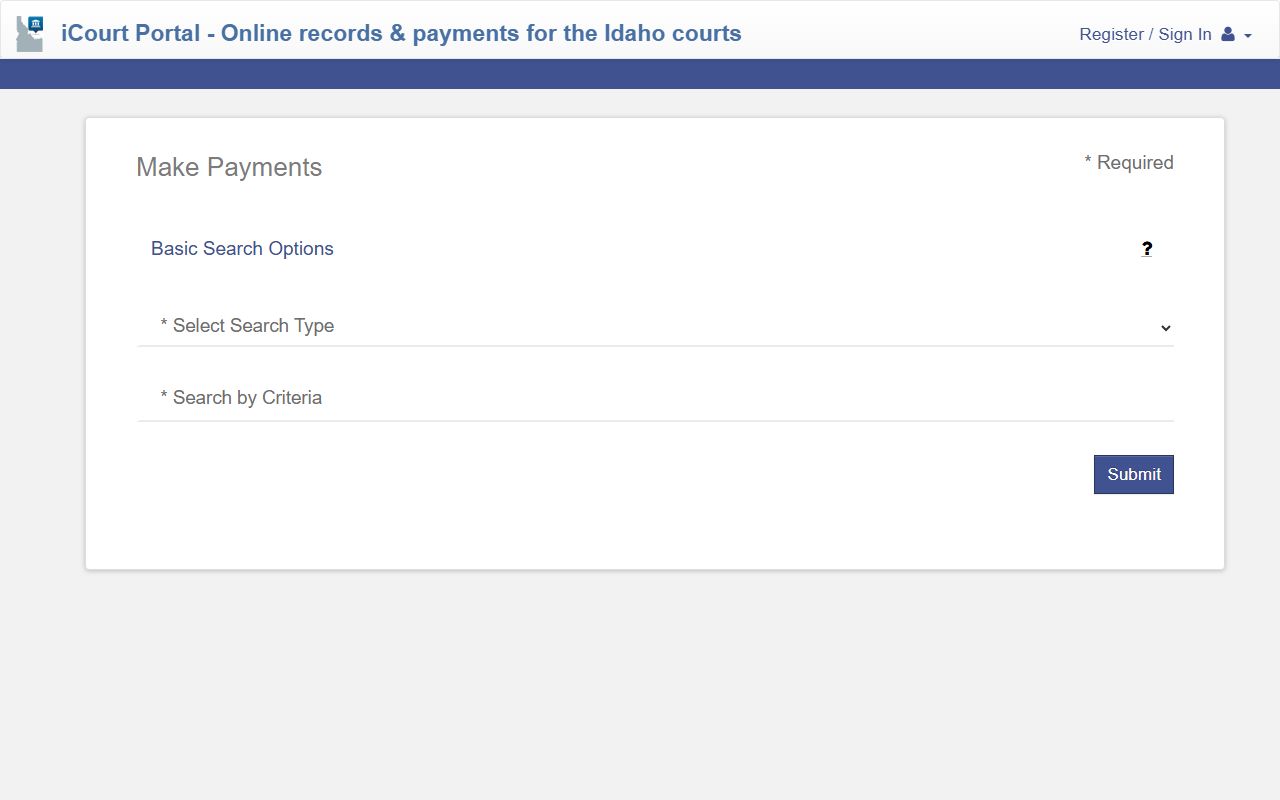
Payment screens should be read with the docket because missed payment-plan terms can create a court date instead of a simple online balance issue.
What Bingham County Docket Entries Show
No public sample Bingham hearing result was opened during research, so docket fields should be described from the official portal fields and court-record instructions. A typical public docket or case event view may show identifiers, scheduling facts, and public status entries. The document itself may still require a courthouse kiosk or a request to the Clerk of the District Court / County Clerk.
| Field | What It Shows |
|---|---|
| Case Number | The court identifier used to connect hearings, events, payments, and copy requests. |
| Party Name | The person, business, petitioner, respondent, defendant, or other party tied to the public entry. |
| Case Type | Whether the docket is criminal, civil, family, probate, mental health, traffic, or another case group. |
| Hearing Type | The public calendar category, such as Bingham - Criminal or Bingham - Family. |
| Judicial Officer | The judge or magistrate assigned to the hearing or case event. |
| Event Entry | A dated notation for filings, settings, orders, continuances, dispositions, or payment status. |
| Payment Eligibility | Whether criminal or traffic fines and fees may be handled through iCourt payments. |
| Disposition | The public outcome of a charge, motion, hearing, or case when the entry is available. |
Courts With Bingham County Dockets
Bingham County dockets flow from the trial courts in Blackfoot and from Idaho's appellate system when a case is appealed. The District Court page names local District Court judges and states that District Court handles serious criminal cases, felonies, major civil cases, post-conviction relief, and appeals from magistrates. The Magistrate Court page names local magistrate judges and covers misdemeanors, traffic infractions, warrants, probate, family, juvenile, small claims, and lower-value civil matters.
- District Court dockets can include felony matters, higher civil cases, post-conviction proceedings, and appeals from Magistrate Court.
- Magistrate Division dockets can include misdemeanors, infractions, warrants, preliminary felony hearings, small claims, family, probate, juvenile, and civil cases up to the county-page limit.
- Small Claims Department settings are handled through the Magistrate Division for informal civil disputes under $5,000.
- Probate or mental-health hearing searches use the Bingham - Probate or Mental Health option in iCourt Search Hearings.
- Appellate docket activity can move to the Idaho Supreme Court or Idaho Court of Appeals after a notice of appeal.
Idaho District Court information places Bingham County in the Seventh Judicial District with Bonneville, Butte, Clark, Custer, Fremont, Jefferson, Lemhi, Madison, and Teton counties.
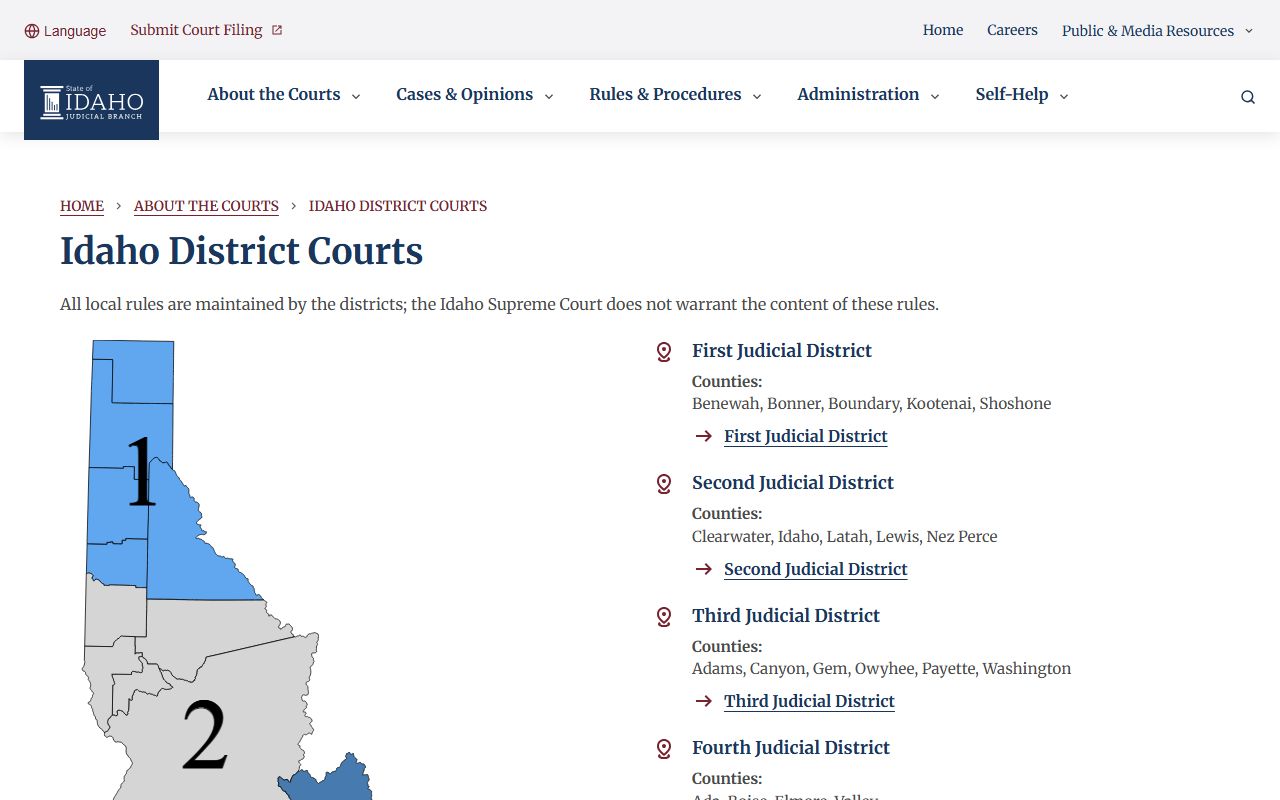
That district context helps explain why Bingham hearings appear in a statewide system rather than a local-only docket database.
Bingham County Dockets vs Case Files
A docket is a tracking tool. It tells what has been filed, scheduled, continued, decided, or paid, but it may not display the full document behind an entry. A case file is the court record collection. It can include pleadings, complaints, informations, motions, affidavits, exhibits, orders, judgments, sentencing documents, payment records, and clerk certifications. For full Bingham County court records, move from the docket to the clerk request process when public copies are needed.
| Point | Docket | Full Case Record |
|---|---|---|
| Format | Chronological list of hearings, filings, and events. | Documents, orders, pleadings, exhibits, and certified copies where public. |
| Online Use | Often available through iCourt Smart Search or Search Hearings. | May require kiosk review or a clerk request. |
| Best For | Checking dates, status, and next steps. | Reading legal claims, court orders, proof of disposition, or sentence terms. |
| Restrictions | Sealed entries and exempt data may not appear. | Confidential files, juvenile matters, and sealed records may be denied or redacted. |
Bingham County Payment Review Dockets
Bingham County's fines and fees page adds a local docket detail that matters for criminal and traffic cases. Misdemeanor and felony fines can be paid online, in person, by phone, by mail, or through the courthouse drop box. Payment plans are reviewed each month by court staff or a magistrate judge. If a person misses a payment or does not pay according to plan, the person must attend a Fine Review Hearing in person.
The researched Bingham County page states that fine review hearings are held the second Thursday of every month at 1:15 PM before a Magistrate Judge. If payments are up to date, attendance is not needed. For payment-plan questions, the research identifies Diana Reese at (208) 782-3117 and dreese@bingham.idcourts.gov. This is not a separate case search portal, but it is a docket-related access channel because a missed payment can place a case back on a public court calendar.
Note: Paying online may not cancel a review hearing unless the court confirms the payment plan is current.
Bingham County Appeal Dockets
Appeals from Bingham County trial courts start in Idaho's appellate system. The Idaho Supreme Court reviews notices of appeal and may assign appropriate cases to the Idaho Court of Appeals. The Court of Appeals does not conduct a new trial or take new evidence. It reviews trial-court decisions for legal error, generally uses three-judge panels, and issues written opinions. Parties may petition the Idaho Supreme Court for review after a Court of Appeals decision.
Idaho Court of Appeals procedures explain how a Bingham County trial docket can become an appellate review matter.
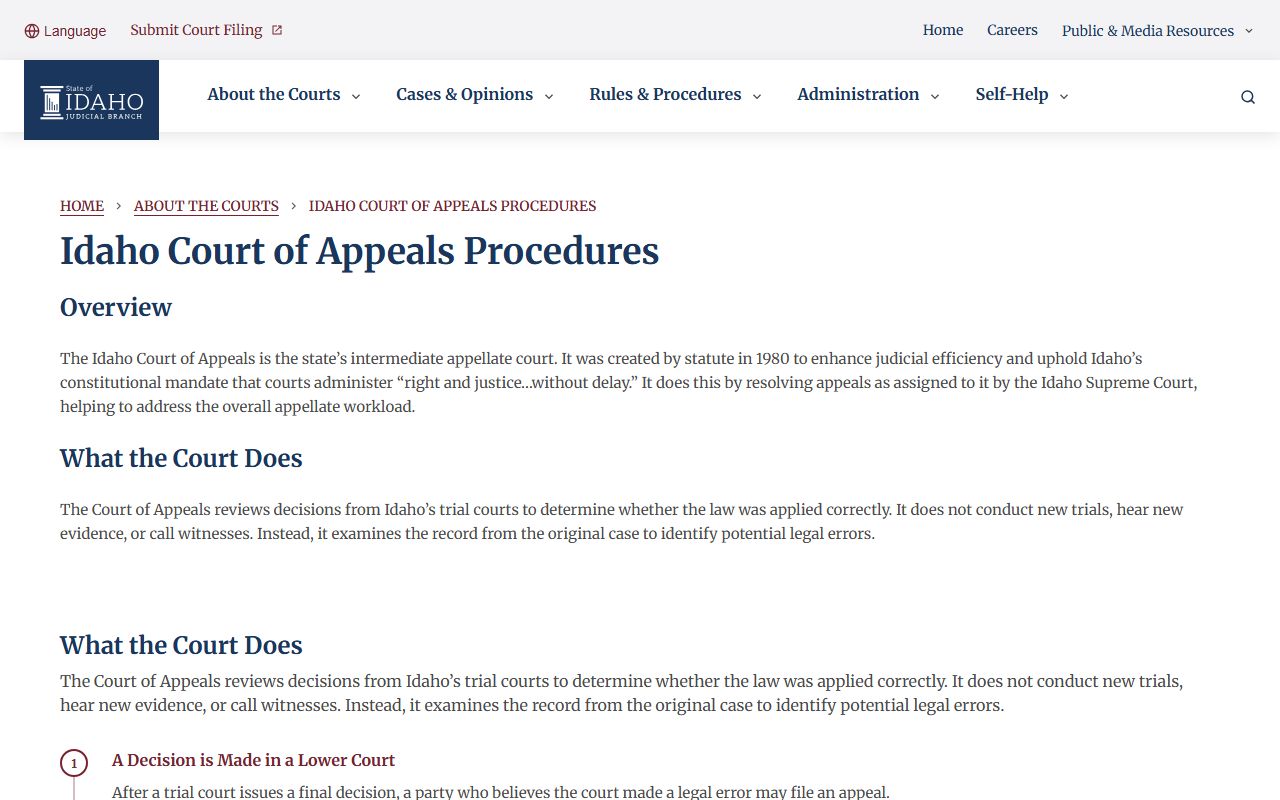
For most county-level searches, start with iCourt, then check appellate sources only when the trial record shows a notice of appeal or appellate review.
Read Bingham County Court Dockets
Docket language is compact. A continuance means a hearing or deadline was postponed. A disposition is an outcome or resolution. A motion is a written request asking the court to act. An order is the judge's directive. A hearing is a scheduled court appearance for a specific issue. A docket entry is the chronological notation that tells when one of those events occurred.
When a Bingham County docket has a confusing event, compare it with the case type and court level. In criminal matters, an arraignment, bond setting, preliminary hearing, plea, disposition, and sentencing each mean different stages of the case. In family or probate matters, a docket may show hearings and orders without showing confidential minor, medical, or financial details. For a complete court record, use the public docket to identify the case number and request the specific document from the clerk.